Management consulting fees are some of the best kept secrets in business. Firms treat their rate cards as confidential, clients sign agreements that keep prices quiet, and the numbers you find online are mostly guesses by people who have never seen an invoice from McKinsey. So when your company is about to hire a firm, or you've been asked to sanity-check a proposal, it's genuinely hard to know whether the number on the last page is fair.
However, numbers do exist. We reviewed publicly available records and spoke to consulting professionals to understand exactly what top firms charge.
In this article, we'll review the headline numbers, work through how firms structure their fees, and break down how to read and negotiate the fees section of an actual proposal.
Download 500+ strategy consulting presentations for free!
Your personal archive of real strategy consulting presentations and proposals from elite firms like McKinsey, BCG, and Bain.

What consulting firms actually charge
Consulting fees scale with the prestige tier of the firm. The industry roughly splits into four tiers, and the same project could cost five times more at the top tier than at the bottom.
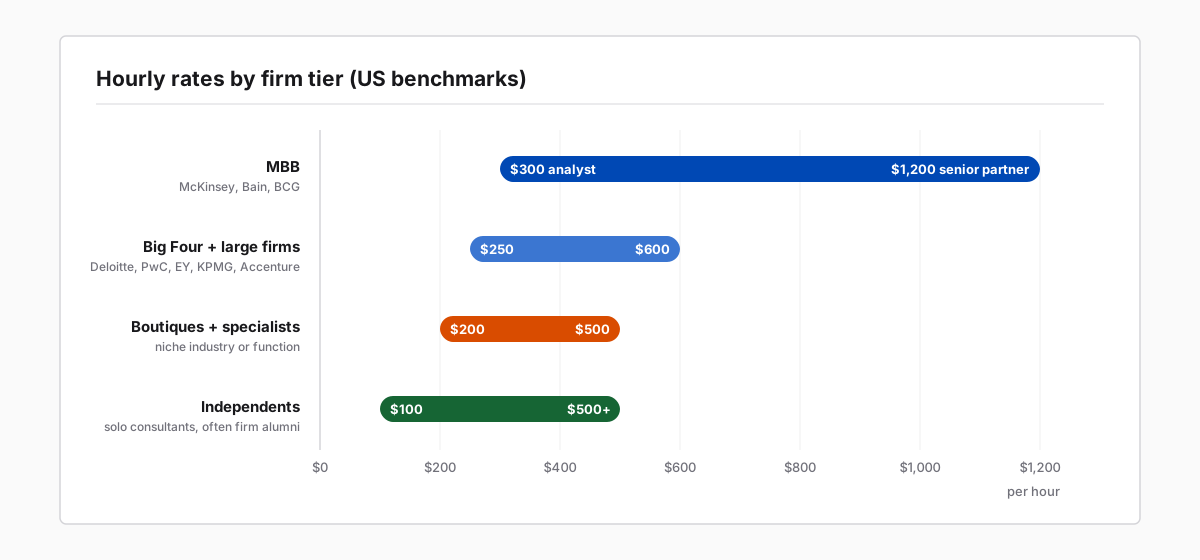
MBB (McKinsey, Bain, BCG). The three big strategy firms sit at the top of the market. Public contracts show McKinsey billing around $1,100 to $1,200 per hour for a senior partner, roughly $800 for an engagement manager (the person running the project day to day), and $300 to $500 for the analysts and associates doing the analysis. A typical project runs $500,000 to $1,500,000 for an 8 to 12 week study, and large transformations go well past $5 million.
Big Four and large consultancies (Deloitte, PwC, EY, KPMG, Accenture). Strong brands with much larger workforces. Hourly rates typically land between $250 and $600 depending on seniority, and projects often come in at half to two thirds of the equivalent MBB price. They also compete on implementation work the strategy firms don't want.
Boutiques and mid-market specialists. Smaller firms focused on one industry or one function (pricing, supply chain, healthcare). Rates commonly range from $200 to $500 per hour. A good boutique can match MBB quality inside its niche at a meaningful discount, which is why procurement teams love them.
Independent consultants. Often alumni of the big firms working solo. Rates vary enormously, from around $100 per hour for generalists to $500 or more for former partners with rare expertise. You're paying for the person, so the variance is the point.
Two things are worth noting about these numbers. First, they're US benchmarks; European rates run somewhat lower and rates in developing markets lower still. Second, hourly rates are mostly a fiction at the top of the market, because the big firms rarely bill by the hour. That brings us to pricing models.
The five pricing models firms use
Every consulting fee you'll ever see is built on one of five models. The differences come down to who carries the risk when a project takes longer than planned.
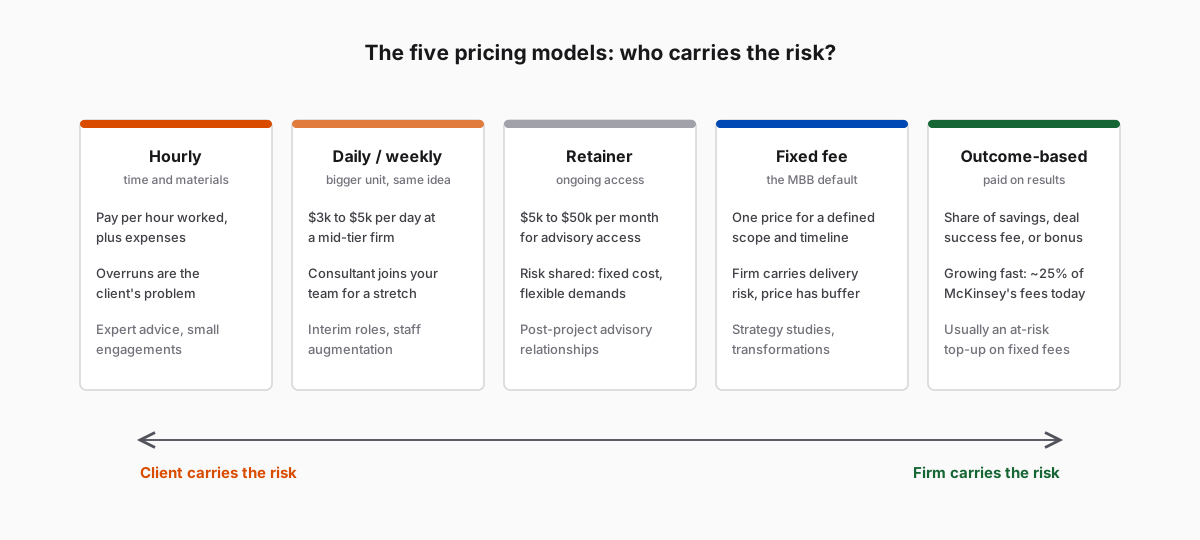
Hourly (time and materials). You pay for hours worked, plus expenses. Simple and flexible, and the client carries all the risk: if the work takes twice as long, you pay twice as much. Common for legal-adjacent work, expert advice and small engagements.
Daily or weekly rates. The same idea with a bigger unit. A senior consultant might cost $3,000 to $5,000 per day at a mid-tier firm. Common for interim roles and staff augmentation, where the consultant effectively joins your team for a stretch.
Fixed fee. One price for a defined scope and timeline, agreed up front. The firm carries the delivery risk, and in exchange the price includes a healthy buffer. This is how the top strategy firms price nearly everything, for reasons we'll cover in a moment.
Retainer. A monthly fee for ongoing access, typically $5,000 to $50,000 per month depending on the firm and the intensity. Common for advisory relationships after a big project ends, when executives want to keep the partner's phone number warm.
Value-based or outcome-based. The fee is tied to results: a share of cost savings, a success fee on a deal, a bonus for hitting a target. For years this was rare in its pure form, because attributing an outcome to the consultant's work is genuinely hard. That is changing fast, and it's worth its own section.
Why the top firms prefer a fixed fee
If you read our collection of real proposals, you'll notice the pattern quickly: MBB firms almost always quote a fixed fee for a fixed period. There are three reasons, and they're worth understanding because they shape how you should negotiate.
First, a fixed fee keeps the conversation on outcomes. Nobody wants to spend steering committee meetings auditing timesheets. The firm wants to be a trusted advisor discussing your strategy, and hourly billing pulls the relationship toward vendor management.
Second, it protects both sides from scope drama. You know your total cost on day one, and the firm has a contractual scope to point at when new requests appear. Anything extra becomes a new phase with a new fee, which is also how firms extend engagements.
Third, it gives the firm staffing flexibility. What you're really buying is a team bundle: typically one partner overseeing two to four consultants full time. A fixed fee lets the firm swap people in and out, use internal experts for a few hours here and there, and manage its bench without renegotiating your contract every time.
The important consequence for you: a fixed fee is an engineered number, built from an internal estimate of people, weeks and rates, plus margin and buffer. Every input in that build-up is negotiable, even when the total is presented as take-it-or-leave-it.
The shift to outcome-based pricing
The biggest change in consulting pricing in years is happening right now: fees tied to results are moving from the margins to the mainstream. McKinsey has said publicly that around a quarter of its global fees now come from performance-based arrangements, where the client names the outcome they want and a large part of the fee is contingent on delivering it. The firm expects that share to keep growing, and EY has talked about moving in the same direction.
Two forces are driving the shift. The first is AI. A growing slice of the analytical work that consulting teams used to bill by the week (data cleaning, benchmarking, first-draft analysis) now takes hours with AI tools, and clients who use those same tools internally have noticed. Paying for effort gets harder to justify when the effort has collapsed; paying for results doesn't have that problem. Bain and BCG have both told investors that AI- and tech-enabled work is heading toward 40 to 50 percent of their revenue, and pricing is following the work.
The second force is the type of engagement. The big firms earn more and more from multi-year transformation programs, where the firm stays through implementation. On a 10 week strategy study, tying fees to outcomes is awkward because the outcomes arrive years later. On a three year program with quarterly targets, it's natural.
If a firm offers you an outcome-based structure, treat the measurement mechanics as the contract's most important section:
- Agree the baseline before work starts. A share of cost savings is meaningless until both sides sign off on what current costs are.
- Pin down attribution. If sales rise while a marketing campaign, a price change and the consultants all happened at once, whose result is it? Write the rule down now, while everyone is still friendly.
- Check what the metric rewards. A fee tied purely to cost reduction rewards cuts you may regret. Pick the metric you'd want optimized, side effects included.
- Expect a hybrid. In practice most deals pair a reduced fixed fee with an at-risk component. That's healthy: the fixed part keeps the firm solvent, the at-risk part keeps it honest.
For you as the buyer, the shift is mostly good news. It gives you a credible alternative to quote when a fixed fee looks padded, and firms that decline any outcome-linked component are telling you something about their confidence in the result.
What real project fees look like
Because public sector work goes through public procurement, we have genuine examples of what full projects cost at the top firms:
- McKinsey proposed roughly $2.5 million to the US Department of the Interior for an organizational efficiency study.
- McKinsey billed the State of Michigan about $7.9 million across a multi-phase transformation program.
- BCG charged approximately $2.85 million for seven months of work supporting Puerto Rico's fiscal restructuring.
- Bain quoted $3 million for a six month operational review at UC Berkeley.
Divide those numbers out and a consistent picture appears: a full-time MBB team costs its client roughly $400,000 to $600,000 per month. Government work is usually discounted, so commercial clients often pay more, and these engagements sit at the larger end of the market. A tightly scoped strategy study with a smaller team lands well under a million.
If you want to see how these numbers are presented in context, the real proposals collection includes the full documents, fees pages and all. Reading two or three of them will teach you more about consulting pricing than any rate survey.
How to read the fees section of a proposal
Sooner or later a consulting proposal lands on your desk and someone senior asks what you think. The fees section is usually one slide or one page, and it rewards a careful read. Here's what to look for.
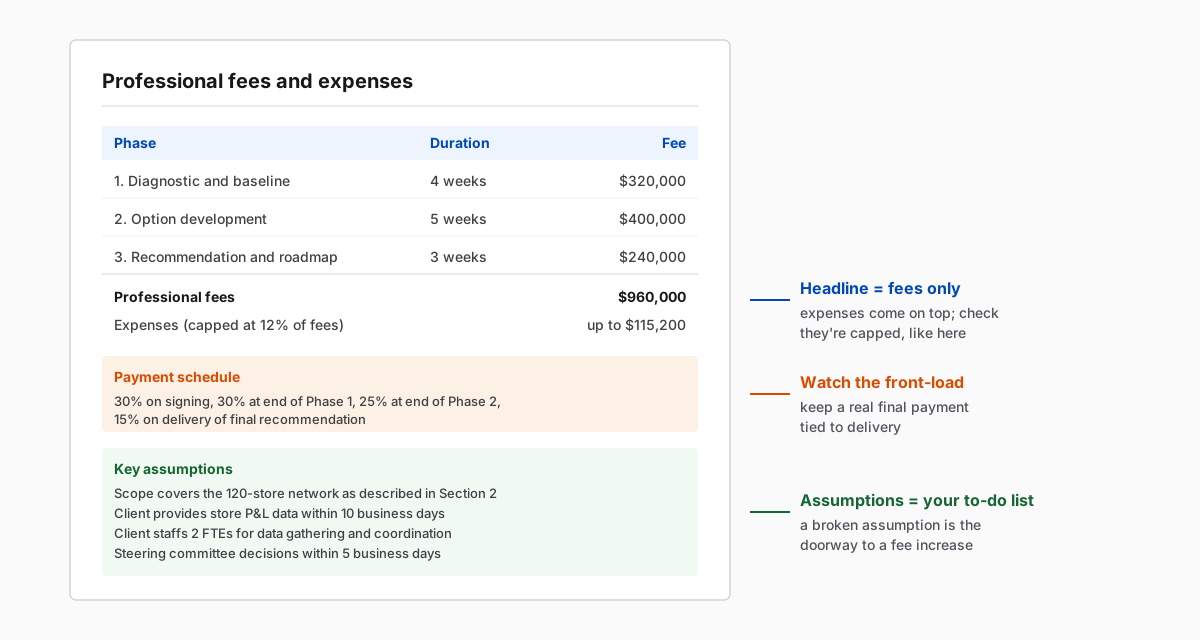
Professional fees versus expenses. The headline number usually covers professional fees only. Travel, data subscriptions and administrative costs are billed on top, historically 10 to 15 percent of fees, less now that so much work is remote. Check whether expenses are capped. If the proposal doesn't say, ask; an uncapped expenses line is a blank check.
The payment schedule. Fixed fees are typically billed monthly or at milestones. Watch for heavily front-loaded schedules, and prefer a schedule with a meaningful final payment tied to delivery. It keeps everyone attentive in the last two weeks.
The assumptions. Somewhere near the fees you'll find the assumptions that make the price valid: the scope stays as described, your data is accessible, your team provides certain inputs, decisions get made within so many days. These matter because a broken assumption is the contractual doorway to a fee increase. Read them as a to-do list for your own organization.
What's excluded. Implementation support, follow-up workshops, extra site visits and additional analyses are often explicitly out of scope. That's normal, but you should know what triggers a change request before you sign, and it's usually cheaper to include a likely extension now than to buy it later.
The team composition. The proposal will name the partner and describe the team. Fee level tracks team composition directly, so this section is where the price actually comes from. Which is exactly where negotiation starts.
How to negotiate consulting fees
Consulting fees are more negotiable than most clients assume, and the effective levers are structural. Discounts for nothing are rare; discounts for changing the shape of the engagement are routine. Take the running example we've used across these articles: a review of an underperforming retail store network. Here's how each lever would apply.
Trim the scope. The single most effective lever. If the proposal covers all 120 stores across three workstreams, ask what a two workstream version looks like, or a pilot on the 30 worst performers. Firms would rather shrink a project than lose it, and a successful pilot gives you leverage on phase two pricing.
Change the team mix. Fees are built from people. One partner with three consultants costs meaningfully less than two partners with five. Ask whether a smaller team over a slightly longer timeline gets to the same answer.
Bring your own analysts. Offer to staff two of your own people onto the team for data gathering and internal coordination. It reduces the firm's hours, builds capability that stays in your company after the consultants leave, and firms generally welcome it.
Use timing. Firms manage utilization (the share of their consultants currently billing), and a team on the bench earns nothing. If your timeline is flexible, say so. Discounts appear near quarter ends and in slow seasons.
Commit to more, pay less per unit. A two-phase commitment or a follow-on retainer is worth a better rate on phase one. Only do this once you trust the firm, and keep an exit gate between phases.
Cap the extras. Cap expenses as a percentage of fees, and agree change request rates up front while you still have leverage. After signing, you're a captive buyer.
One honest caveat: if the decision is already politically sensitive, a rock-bottom price can work against you, because a big-name firm's fee is partly what makes its recommendation authoritative with your board. Negotiate the structure hard, then let the brand do what you hired it for. And when the engagement ends and your own team inherits the deck production, the standards survive the handover better with support; that's the gap our PowerPoint add-in SlideBrain is built for, reviewing and polishing your slides to a consulting standard right inside PowerPoint.
FAQ
What is a reasonable management consulting fee?
It depends on the tier. For a solo consultant, $150 to $300 per hour is a normal professional range. For a boutique firm, expect $200 to $500 per hour. For a full MBB team, a reasonable benchmark is $400,000 to $600,000 per month, all in. The fee is reasonable when it's small relative to the decision it supports: paying $800,000 to get a $200 million investment decision right is cheap insurance.
How much do McKinsey consultants charge per hour?
Public contracts show McKinsey's rates running from roughly $300 to $500 per hour for analysts and associates up to $1,100 to $1,200 per hour for senior partners. In practice McKinsey rarely bills hourly; those rates are the internal build-up behind a fixed project fee.
Is $100 an hour good for consulting?
For an independent consultant, $100 per hour is an entry-level rate. It sounds high next to a salary, but a consultant's rate has to cover unbillable time, benefits, insurance, tools and business development. Experienced independents typically charge $200 or more, and specialists with rare expertise charge several times that.
What is the rule of 3 in consulting?
A common shorthand for setting rates: take the equivalent salary cost and multiply by three, with one third covering the person's pay, one third covering overhead and unbillable time, and one third profit. It explains why a consultant whose salary would be $150,000 bills out at $450,000 or more per year, and it's a useful sanity check on any rate you're quoted.
Why are management consulting fees so high?
You're paying for a concentrated burst of senior attention, an outside perspective with no internal politics, pattern recognition from dozens of similar problems, and the credibility a known brand lends the answer. Whether that's worth it depends less on the fee and more on the size of the decision. On a genuinely large decision, the fee is rarely the expensive part; the expensive part is deciding wrong.